
What do you need to know about the energy label? PENB plays a role in the sale of a property, so let's get clear on it.
Building Energy Performance Certificate (PENB), often also called energy label of the building, is an official document that assesses how much energy a building consumes to operate. Based on the calculation of the total energy consumption (heating, water heating, cooling, ventilation, lighting, etc.), PENB classifies a building into energy classes From A (extremely economical) after G (extremely wasteful). This certificate is required by law in a number of situations and serves both the seller and the landlord, as well as the buyer or tenant - providing clear information about the energy efficiency and running costs of the property. In the following article we explain, what PENB is, when it is needed, who provides it, what exceptions existwhat is price and validity passport and what to look out for when selling or renting an apartment, house or cottage. At the end we will also add an overview FAQ with the most common questions on this issue.
What is a PENB (building energy performance certificate)
PENB is a document that quantifies all energy consumed in the standard operation of the building and clearly assesses the energy efficiency of the property. The result of the assessment is energy class letter A-Gsimilar to what we know for energy appliances. In addition to the class itself, the certificate also contains other information about the building - for example size and age of the building, type of construction, heat source for heating and water heating etc. Each certificate includes a graphical representation of the energy performance (a colour label with the class) for quick visual reference.
The energy performance certificate of the building is prepared by an authorized energy specialistbased on detailed calculations. The specialists take into account the thermal-technical characteristics of the building (e.g. insulation, windows, heating system) and the standardised annual energy consumption for heating, cooling, ventilation, water heating and lighting.It is therefore not an estimate or a mere accounting of consumptionbut a professionally calculated indicator. The resulting passport is then used mainly to informbuyers or tenantsabout how energy-intensive they can expect the building to be and allows for a comparison of properties in terms of their energy efficiency.
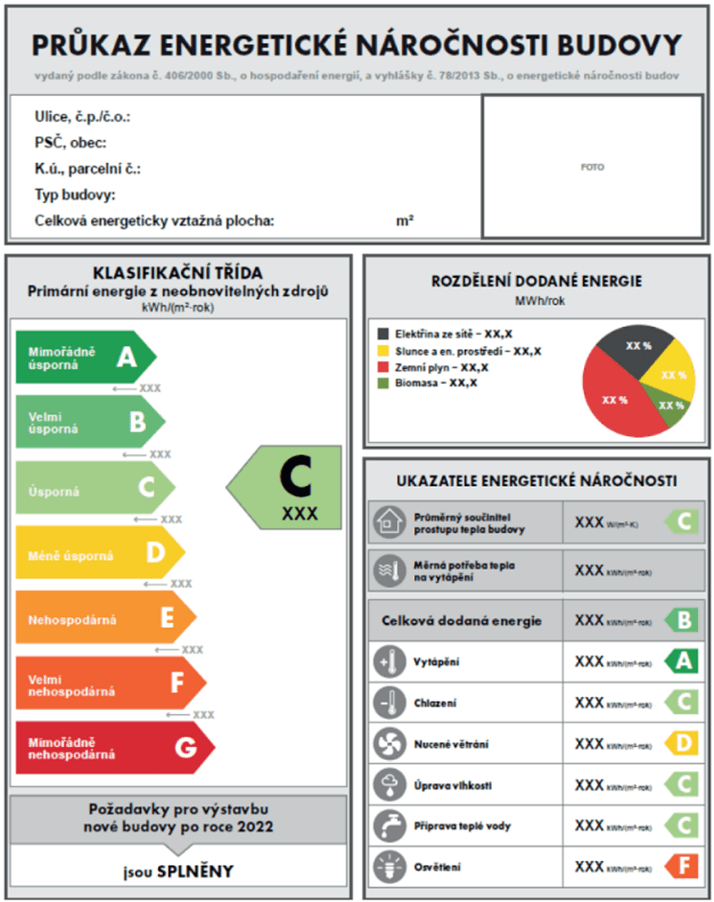
Current form of the PENB label
When is PENB needed?
The obligation to have a PENB prepared is stipulated by the Energy Management Act for several situations. In simple terms, the following applies you must always have an energy performance certificate for your buildingwhen it comes to construction, sale or lease of real estate (except as provided by law - see below). Specifically, the building owner (or the community of unit owners in the case of apartment buildings) is obliged to provide PENB in the following situations:
New construction or major renovation of the building: At construction of new family houses, apartment buildings or holiday homes the PENB is already required for approval. Similarly, when larger change of the completed building (typically extensive renovations affecting more than 25 % of the building envelope), a new PENB should be prepared before the modifications are completed. The aim is to verify that the building meets the current energy efficiency requirements - for example, new houses are now being built to achieve at least Class B.
Sale of real estate (building or complete part of a building): If you are selling a family house, a flat in private ownership or a cottage, you must have a valid PENB and present it to the buyer no later than when signing the purchase contract. This obligation has been in force since 2013 and applies to the sale of the entire building, for example individual housing units (in this case, the pass for the whole house is usually provided by the JVU - see below). Already in the advertising phase you must additionally in indicate the energy class in the offer of the property according to PENB (e.g. "Class C - economical"). If you don't already have a licence, the law requires you to indicate the worst class G (wasteful). However, quoting G-class "just in case" is not ideal - on the one hand, you risk a penalty of up to CZK 100 000 for failure to comply with the obligation, and the letter G may discourage applicants (it may give the impression of an energy-inefficient property). It is therefore worth obtaining the certificate in good time before the sale.
Rental of real estate (building or part thereof): The same obligation applies in the case of rent - both the whole house and since 2016 also when renting an apartment or non-residential unit in a building. The lessor is obliged to submit a valid PENB to the tenant when you sign the lease agreement at the latest. You must therefore also indicate the energy class in the advertisement for the lease of the flat or house, just as you would when you sell it. Unfortunately, many landlords are unaware of this obligation or ignore it, but the law is quite clear. Liability cannot be waived even by agreement with the tenantthat "PENB is not needed" - such an agreement has no legal weight and the obligation to have a certificate remains.
In a nutshell,You will always need a PENB when you build, sell or rent a property(unless it falls under the exceptions below). An exception istransfer of property off the market, for example ininheritance or donationwhere a licence is not compulsory. In all other cases, however, it is better to count on the fact that you cannot do without PENB - both to comply with the law and to inform those interested in buying or renting.
How to get PENB?
The owner of the property is responsible for providing the energy performance certificate for the building. The seller or landlord is legally obliged to have the PENB prepared (or requested from the HOA for flats) at his own expense and to hand it over to the buyer or tenant in due time. In practice, this means that you must order the certificate from professionally qualified persons - called. energy specialist with valid accreditation of the Ministry of Industry and Trade. These specialists (individuals or companies) can be found in the official list of the MIT or through the energy audit website. PENB can only be issued by an accredited professional, not, for example, a civil engineer without specialisation or a layman.
A specific situation arises with flats in apartment buildings.Here the law provides thatPENB is provided for the whole building by the community of unit owners (COU)or cooperative. The owner of the flat who sells it has the right torequest in writing to SVJ for a copy of the PENB. Ideally, the apartment building already has a certificate (the PENB for the apartment building is valid for all apartments in it) and the apartment owner simply obtains it from the building manager. However, ifSVJ does not have PENB processed, there may be a problem - the owner of the apartment stillthe legal obligation to sell must be fulfilled. The solution is eitherhave a PENB prepared for your apartment unit at your own expense(which the legislation allows), or usealternative solution: present to the buyerenergy consumption accounts for the last 3 yearsoperation of the apartment. This exemption is enshrined in the law for the case of inactivity of the HOA. However, it is not ideal - the billing does not fully replace a comprehensive assessment of the building. Therefore, it is better if the HOA has a joint certificate prepared for the whole building (the costs are shared among all unit owners). For family houses, holiday homes or commercial buildingsthe owner (seller/landlord) is always responsible for obtaining the licence.
Exceptions to the PENB obligation - when do I not have to deal with PENB?
The law also takes into account situations where the obligation to provide an energy certificate would not make sense or would be an unnecessary burden. Exceptions to the PENB obligation relate in particular to small, historic or specific buildings and certain real estate transfer cases. Below is an overview of the main exceptions, where you do not need to have an energy performance certificate:
Small buildings up to 50 m²: Detached buildings with energy reference area up to 50 m² (e.g. smaller cottages, garden houses, garages) does not need to have a PENB prepared. This exemption does not apply to flats (the area of the flat is calculated within the total area of the building) or to houses larger than 50 m².
Holiday properties (cottages, chalets) used only part of the year: If the building is officially registered as building for family recreation and it is used only seasonally, the law exempts the obligation to have a PENB. Typically, this is the case when a cottage or chalet not permanently heated all year round and its energy consumption is less than the 25 % of annual consumption that would correspond to year-round operation. Please note: In the land registry it must actually be a holiday home, not a family home - the official purpose of the building is decisive.
Historic and listed buildings: Buildings that are declared cultural monument or are located in a conservation area, are exempt from the PENB requirement. The exception also applies to very old buildings Built by before 1947if since then have not undergone major changes(modernisation) - in this case it is not necessary to obtain a pass if the seller and the buyer agree in writing. This agreement shall replace the surrender of the licence. It is important, however, that the condition is the original condition of the building without major renovation; for partially modernised houses from the first half of the 20th century, it is better not to rely on the obligation and have the PENB.
Industrial, agricultural and other unheated buildings: Objects such as industrial halls, agricultural buildings, workshops or warehousesin which energy consumption does not exceed 700 GJ per year and which are used exclusively for production or storage purposes. Similarly, certificates are not required for buildings with minimal energy equipment (e.g. some barns, warehouses without heating, etc.).
Buildings without a description/registration number: Some buildings are not approved as buildings for living or recreation and do not have an assigned descriptive or registration number. Typically, this can be some sheds, gazebos, garages etc. Such buildings do not fall within the definition of a building for the purposes of the Act, and a licence is not required for them.
Inheritance, donation and transfer of cooperative shares: If the property is being transferred free of charge(by donation) or as part of Heritage, there is no need to document the PENB. Similarly, when transferring cooperative apartment (membership rights in a housing association) is not a sale of the property as such, and no licence required. However, in the case of cooperative flats, the card is applied when the cooperative sells the entire house to the personal ownership of the members (transfer to the OV).
These exceptions cover the most common cases where the law does not require an energy performance certificate.In other situations, however, a valid PENB is required- the obligation cannot be relied upon to be circumvented. For example,if you are selling a standard family house or apartment, none of the exemptions are likely to apply to you and you will need to provide proof of ID. Otherwise, you risk not only penalties but also complications during the sale (the buyer may ask for the licence afterwards, the authorities may fine you, etc.). It is therefore always better to comply with this legal obligation.
What is the validity of PENB?
Validity of PENB is set at 10 years from the date of issue. This means that you can use the card repeatedly, for example for multiple rentals, or if you don't sell the property immediately and offer it again later, the card is still valid (unless 10 years have passed). Beware, however, of major changes to the building: If during these 10 years you make major renovation or modificationthat can affect energy performance (e.g. facade insulation, boiler replacement, installation of solar panels, etc.), it is necessary to have a new PENB issued Before. A significant change could move the building into a different energy class, and the original certificate would no longer reflect reality.
Also keep in mind that failure to comply with the PENB obligation can become more expensive. The State Energy Inspectorate may impose a fine of up to 100 000 CZK individuals (and up to CZK 200,000 for legal entities) for violation of the law. Therefore, if you sell or rent a property without a valid licence (and you do not fall under any exemption), you run the risk of a penalty. In addition to the financial penalty, the buyer may also demand the delivery of the certificate or the estate agent may refuse to advertise the property without the energy class. Investing in a PENB is therefore definitely worthwhile - compared to fines and for the smooth running of the business.
PENB Frequently Asked Questions - FAQ
Is the PENB obligatory even when renting an apartment or house?
Yes, the licence requirement also applies to renting. From 1 January 2016, they must have energy performance certificate and landlords of flats and, of course, entire houses. The landlord is obliged to provide the tenant with the PENB (or a certified copy thereof) at the latest when signing the lease agreement and indicate the energy class of the apartment/house in the advertisement. Many people don't know about this, but the law requires it just like for sales. Unless the landlord provides the certificate to the tenant, violates the law - the tenant could theoretically withdraw from the contract or denounce the landlord and face a fine. An agreement like "the tenant doesn't mind the ID, we don't need it" not legally valid and does not relieve the obligation.
Who pays the costs of PENB when selling a property?
Costs of making the card is borne by the seller (owner) real estate. It is his legal obligation to secure a certificate before the sale, so he usually orders and pays for the services of an energy specialist himself. For apartment buildings, the PENB should be prepared by the property manager/SVJ at the joint expense of the building (as the certificate serves all units) - in practice, however, the initiative often remains with the individual seller if the house does not have a certificate. For the buyer, the certificate should be available for free as part of the sale. In the case of a lease, the situation is similar: the owner of the property has the certificate prepared at his own expense and the tenant only takes it from him for inspection.
How long does it take to develop a PENB and how long is it valid for?
It depends on the workload of the specialists, but usually production time is around 1-2 weeks from the delivery of the documents. Simpler passes (e.g. for a smaller family house with available documentation) can be ready within a few days, while complex objects or periods of the construction season can prolong processing. We therefore recommend ordering processing well in advance of the planned sale or lease to ensure you have the pass in hand in time. Regarding validity, PENB valid for 10 years from the date of issue, unless there is a major structural change to the building (then a new certificate must be issued). So, for example, you can reuse a 2015 pass until 2025 for multiple transactions (assuming the building has undergone only routine maintenance).
Do I need a PENB even when selling a cooperative apartment?
PENB is not required for the transfer of a cooperative share (cooperative apartment). This is not a classic sale of real estate - legally it is a transfer of membership rights in a housing cooperative, and the legal obligation to provide a certificate applies only to the sale of real estate as such. Therefore, if you are "selling" a condominium (transferring a share), you do not have to provide the buyer with an energy performance certificate. Attentiononce the apartment has been transferred to private ownership (OV) and subsequently sold, the obligation would already apply. Also, if the cooperative were to sell its entire house to another company, for example, a PENB would be needed. But for a normal transfer between members of a co-operative you do not need to secure a certificate - this exception is explicitly stated in the law.
What is the risk if I don't have a PENB and sell the property without it?
First of all, you risk a possible fine of up to CZK 100 000 from the State Energy Inspectorate for violation of a legal obligation. Although the authorities do not control every transaction, they can intervene randomly or on the basis of a complaint. Furthermore, there may be a problem on the buyer's side - if you have not handed over the card, may withdraw from the contract, or request a discount or additional card. Also real estate agents usually require knowledge of the energy class before advertising - so without a certificate, a reputable agent will either not take the property up for offer or will advertise it with the classification "G" (worst)which may discourage interested parties. Overall, sales without PENB may be complicated and prolonged. The recommendation is clear: always get a compulsory licenceeven if it means a small expense and delay. This avoids potential legal and financial problems and gives the buyer proper documentation for the property, which increases their confidence in the whole deal.
Are you considering selling a property? I will advise you for free
As a real estate broker specializing in the sale of apartments, houses, land and commercial properties, I offer clients not only services during the sale itself, but also consultations on tax obligations and strategies to legally minimize taxation of profits.
Feel free to contact me if:
you are selling a property and don't know whether you will be taxed,
you are considering an investment and want to know the tax consequences,
you need help estimating the market price.
Contact: +420 731 098 231
 michal.blaha@re-max.cz
 www.blahareality.cz
You don't know what to do? Let me help you


 English
  Czech
Czech  German